


Cold forming / cold heading
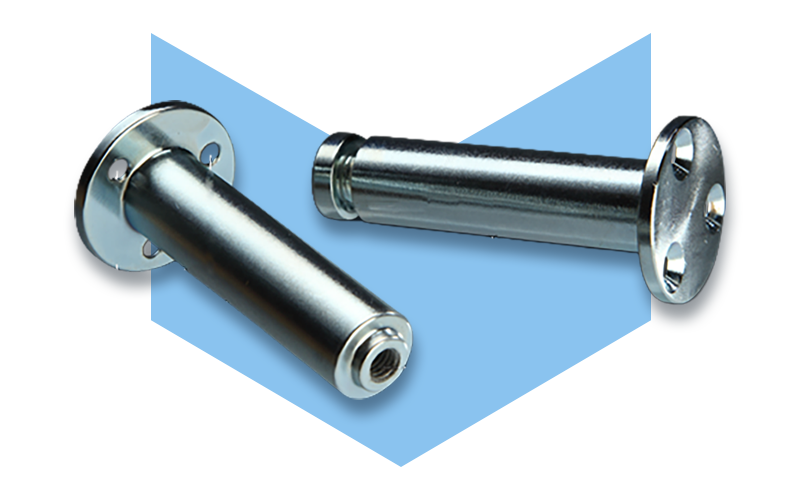
In cold forming, wire or bar stock is shaped at room temperature in one or several pressing steps. This process is particularly suitable for screws, bolts, rivets, pins, and simple formed parts.
The advantage: cold forming produces no chips like machining. This saves material and makes the process significantly more cost-efficient than machining at high volumes. Unlike machining, cold forming maintains an uninterrupted grain flow. This ensures that the internal structure of the material follows the contour of the part, leading to significantly higher fatigue strength and durability.
Typical applications:
- Hex and socket head screws
- Bolts and pins
- Blind rivets and tubular rivets
- Drawing parts
Hot forming
In hot forming, the material is heated before the forming process. This makes it softer and easier to shape—ideal for larger cross-sections, more complex geometries, or materials that cannot be formed economically when cold.
Typical applications:
- Large screws and anchor bolts
- Flanges and head bolts
- Parts with large heads or complex transitions

Rolling and thread rolling
Threads on fasteners are often not cut; they are rolled. Our thread rolling process creates an uninterrupted grain flow at the thread root. The result: smoother surfaces, higher strength at the thread root, and longer service life.. We also produce profiles, knurls, and grooves cost-effectively by rolling.

Open die forging
In open-die forging, the heated material is shaped step by step between simple, non-contoured tools (dies) through repeated blows or pressing operations. Unlike closed-die forging, there is no closed tool that defines the final contour—the workpiece is turned and repositioned between forming steps.
This process is particularly cost-effective for large components, small batches, and custom parts where specialized pressing tools are not economical. Repeated deformation creates a dense, fibrous grain structure, ensuring high strength and exceptional durability of the material.
Typical open-die applications:
- Large bolts, shafts, and axles
- Prototypes and single parts
- Semi-finished products and blanks for subsequent machining
- Special and drawing parts with large cross-sections or high strength requirements

Materials: forming works with a wide range of alloys
- Carbon steels (e.g. C10, C35, C45) – the standard material for screws and bolts
- Alloy steels (e.g. 10.9, 12.9 according to ISO 898) – for high-strength connections
- Stainless steel (e.g. A2, A4) – corrosion-resistant, e.g. for medical technology or the food industry
- Aluminium and copper alloy – for lightweight construction and electrical applications
- Special alloys (e.g. chromium-molybdenum steel for stretch bolts) – for extreme loads
When does forming pay off vs. machining? These 3 factors decide
The choice between forming and machining depends on three factors: volume, geometry, and material.
- High volumes: from a few thousand parts, forming tool costs are usually amortised quickly. Unit costs are then significantly lower than machining.
- Simple to medium geometries: symmetrical parts with heads, shanks, and threads are ideal for forming.
- Strength requirements: cold forming increases strength through material densification—a natural advantage over machining.
Our engineers use Value Engineering to find the most efficient manufacturing path. We help you reduce your Total Cost of Ownership (TCO) by optimizing material use and choosing the right forming process early in the design phase.
Forming: from drawing to serial production
- Request & consultation you describe your part; our engineers check whether forming is the ideal process.
- Tool design: we design a tool for cold or hot forming tailored to your part.
- Sampling: first parts are pressed, measured, and released together with you.
- Serial production: after release, production starts—with defined inspection intervals and documentation.
- Post-processing (optional): thread rolling, heat treatment, surface coating—everything from one source.
It depends on part complexity and tool costs. In practice, a stamping tool is worthwhile if the total costs over its entire service life are lower than those of other processes.
In addition to the quantity required, the volume of material that can be processed also plays a role. Stamping processes often involve defined minimum order quantities (e.g. coil sizes). We therefore assess the economic viability of each enquiry on a case-by-case basis. For standard parts with high volumes, the break-even point is often much lower.

Cost-efficient production starts with choosing the right process.
We advise you on forming, tool costs, and serial production.
Phone +49 5741 3480-0
Email info@daniel-gruppe.de
Knowledge that connects
Expertise from engineering, purchasing and manufacturing – written clearly for decision-makers in SMEs.


